Enhanced Configs
Enhanced Configs remain the service-definition mechanism for rich configuration forms in Ambari 3.1. A service theme supplies UI metadata without requiring changes to shared UI code.
Configuration Resolution
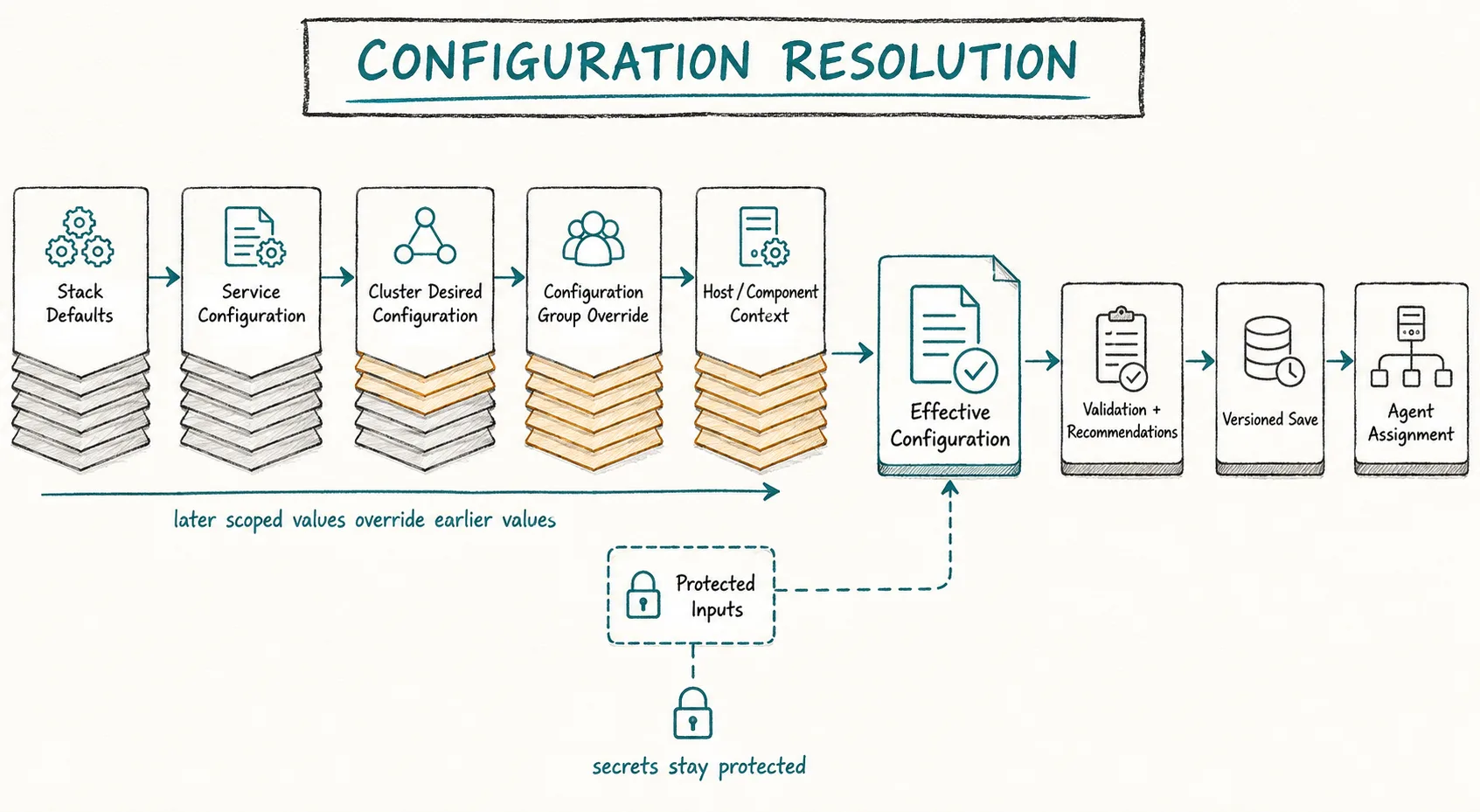
Ambari resolves the Stack defaults, cluster desired configuration, matching configuration-group overrides, and host or component context into one effective value set. Protected inputs follow the credential path instead of being copied into ordinary service properties. The resulting configuration is validated and versioned before assignment to Agents.
Metadata Model
Themes define layouts, placement, and widgets. Layouts describe tabs, sections, and subsections. Placement binds configuration keys to subsections. Widget metadata binds a configuration to controls such as sliders, lists, toggles, directories, passwords, text fields, checkboxes, and text areas.
Configuration metadata supplies display-name and value-attributes, including type, minimum, maximum, unit, increment-step, and enumerated entries. depends-on properties form a directed dependency graph; a change can trigger Stack Advisor recommendations for dependent values.
Effective Conditions And Validation
The effective form combines Stack defaults, service configuration metadata, the selected theme, and the current configuration values. A widget's display unit can differ from the persisted unit; conversion is applied when values are shown or saved. Validation enforces declared types, ranges, enumerations, and required values before a configuration can be submitted.
Dependency updates are scoped to changed properties. The recommendations request receives the changed configuration list and returns only affected dependencies. Invalid metadata, unsupported widget definitions, or values outside declared constraints must be corrected before saving.
Complete Native Documents
The runtime mpack follow-up uses content properties to manage complete native files for ten reference services, including PostgreSQL and Nginx. Configuration Files and Basic Settings have different responsibilities: application documents coexist with managed identities, paths, credentials and listener inputs. See Edit Complete Configuration Files for migration, configuration-group inheritance, validation and recovery boundaries.
Save And Reload
Ambari saves the resulting configuration through its normal configuration APIs. Changes to a theme or Stack definition require restarting Ambari Server so the metadata is reloaded. Themes are retained in 3.1; the removed legacy monitoring widget model is unrelated to these configuration-form controls.
See the pinned theme and configuration implementation for current Stack-owned metadata.